
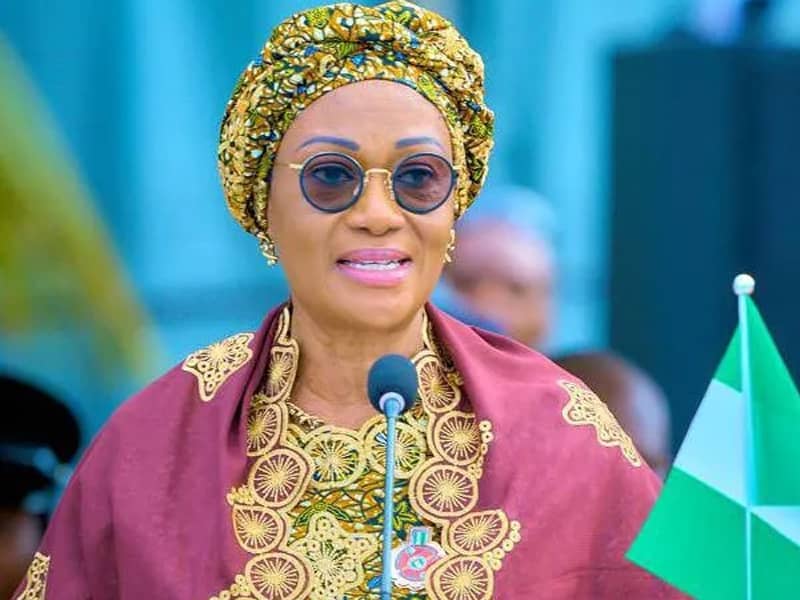
Nigeria’s First Lady’s Visit To The Historic Town Of Akwete, An Unprecedented Gesture Capaple Of Rekindling The Abia Economy.
Nigeria’s First Lady’s Visit To The Historic Town Of Akwete, An Unprecedented Gesture Capaple Of Rekindling The Abia Economy.
Nigeria’s First Lady’s Visit To The Historic Town Of Akwete, An Unprecedented Gesture Capaple Of Rekindling The Abia Economy.
Tuesday (Afor) 21-07-2026.
In the annals of Nigeria’s history, there has never been any written or oral record of a visit by any Nigerian First Lady to the historic Weaving Town of Akwete-Ndoki, in Ukwa-East Local Government Area of Abia State.
Therefore, the visit today, Tuesday (Afor) 21st July, 2026 to Akwete by the First Lady of Nigeria, Her Excellency, Senator Oluremi Tinubu, CON, is maiden, unprecedented, and historic.
It will be recalled that Akwete was one of the few towns in Igbo land that came into contact with western civilization very early, even preceeding British Colonization of the Northern and Southern Protectorates of Nigeria.
By way of historical facts, Akwete was the British Colonial District Headquarters pronounced in 1896, following British Colonization Treaty of 1892. A District Commissioner to man the District, Mr Frederick Seton James, was appointed in 1897. Akwete, by virtue of that administrative status, was the colonial headquarters of what later became Aba Administrative Division.
The headquarters that was in Akwete was, for administrative convenience, moved to Aba in 1903. One of the reasons for the relocation was the Colonial Government’s anticipation to site the headquarters along the Enugu-Aba-Port-Harcourt Railway corridor, which was meant to facilitate carriage of coal from Enugu to Port-Harcourt, for onward transportation overseas. Construction of the Eastern Rail Line started in 1913 and was completed in 1916.
Apart from the obvious fact that Akwete was a Colonial District Headquarters in Igbo land, the people of the town were known for two main traditional occupations. While the men were fishermen, as Akwete is a riverine community, the women were certified traditional weavers.
Weaving in Akwete, which combined elements of beautification, magnificence, and decency, was, has been, and remains an industry that gave birth to a brand known as, and called Akwete Clothes. The Akwete Clothe is in the class of Iseyin Aso Oke Clothe in Yoruba heritage, and Kente Clothe of Ashanti people of Ghana.
The leaders of Akwete, knowing both the economic and social significance of the brand, made sure the industry was made an integral part of Akwete culture, economically and socially. Hardly did a female child grow up in Akwete without having a sustainable occupation on which her future revolved, and that was weaving.
To this effect, Akwete Weaving Co-operative Society was established in 1963 to assist women weavers procure raw materials, such as yarn, from firms at reduced prices. As long as Akwete is concerned, weaving is not just an occupation but a phenomenon.
The Akwete weaving industry, which has created a lot of employment, directly and indirectly, with a good picture of aesthetics, has not received the attention and encouragement that it deserves from Governments in the past. Apart from the current Governor of Anambra State, Professor Chukwuma Charles Soludo, who publicly announced his policy of wearing the Akwete Clothes, no Government has directed much attention to the Akwete Weaving Industry and heritage. Yet, the industry has continued to survive from generation to generation.
It is, therefore, interesting, motivating and assuring to know that the First Lady of the Federal Republic of Nigeria, Her Excellency, Senator Oluremi Tinubu, CON, has decided to break a jinx of more than One Hundred Years by paying an official visit to Akwete in order to ‘celebrate and promote’ Women Weavers of Akwete Weaving Industry. It is, indeed, a welcome development.
This visit will definitely impact very positively on patronage the Akwete Clothes have received before now. It will surely open a large space of demand for the industry and, at the end, promote the prospects of the industry, enhance the earning capacity of the local women weavers, create more employment, and help grow the economy of both Abia State, and the Nigerian State.
Kudos should be given to the First Lady of Abia State, Her Excellency, Mrs Priscilla Chidinma Otti, for her unwavering effort which has manifested in drawing the attention of Her Excellency, Senator Oluremi Tinubu, CON, to the historic but not-much-talked-about Akwete Weaving Industry.
Equity Global Reporters Ltd joins thousands of patriotic Abians to say a very hearty welcome to the First Lady of Federal Republic of Nigeria.
Sir Don Ubani is a former Commissioner for Information and Strategy in Abia State, and Publisher of Equity Global Reporters Ltd.