
Civil Society Decries FOI Non-Compliance, Demands Transparency at Grassroots
Civil Society Decries FOI Non-Compliance, Demands Transparency at Grassroots
Civil Society Decries FOI Non-Compliance, Demands Transparency at Grassroots
Civil society organisations have renewed calls for greater transparency and accountability in local governance, warning that persistent non-compliance with Nigeria’s Freedom of Information (FOI) Act is weakening grassroots administration, deepening poverty and eroding public trust.
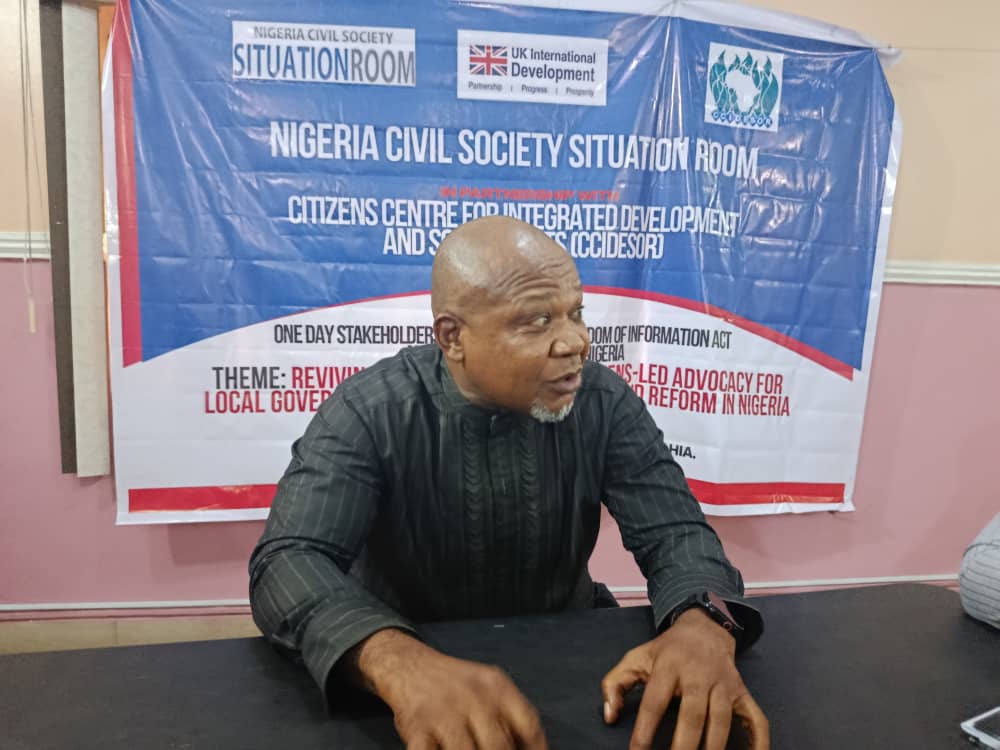
The demand was made at a one-day stakeholders’ roundtable in Umuahia, Abia State, held under the theme “Reviving the Grassroots: Citizens-Led Advocacy for Accountability and Reform in South-East Nigeria.”
The event was organised by the Citizens Centre for Integrated Development and Social Rights with support from the Nigeria Civil Society Situation Room. It drew civil society actors, legal practitioners, community leaders and governance advocates.

Delivering the lead paper titled “Freedom of Information Act in Nigeria: Proactive Disclosure, Compliance Obligations and Action Points,” the convener, Dr Emeka Ononamadu, said the 2011 FOI Act was enacted to move public administration from secrecy to openness. However, he noted that the law has suffered widespread neglect, particularly among ministries, departments, agencies and local governments.

He explained that the Act is built on three key pillars: proactive disclosure of information without formal requests, routine disclosure upon request, and mandatory compliance supervised by the Attorney-General of the Federation.
According to him, poor record-keeping practices, institutional resistance and weak enforcement mechanisms have made access to information “an exception rather than a right.” He stressed that failure to maintain proper records constitutes a violation of the Act.
Ononamadu described proactive disclosure under Section 2 of the Act as the most transformative but least implemented provision.
The section mandates public institutions to regularly publish information on their structure, functions, budgets, contracts, audits, personnel and decision-making processes through print and digital platforms. He added that citizens have the right to seek judicial redress when institutions fail to comply.

Also speaking, Barrister Uche Nwokocha examined the practical application of the Act at the local government level.
She said the law grants any individual or organisation the right to access public records without showing specific interest.
The Act, she noted, applies not only to government institutions but also to private entities performing public functions or managing public funds.
Nwokocha emphasised that access to information is fundamental to democratic participation and freedom of expression. She explained that citizens can request details of local government budgets, expenditures, contracts and service delivery records. A failure to respond within the timeframe stipulated by law, she said, amounts to a refusal that can be challenged in court.
While acknowledging exemptions relating to national security and personal privacy, she maintained that public institutions bear the burden of justifying any denial of information.
She added that judicial decisions at national and regional levels have upheld the enforceability of the FOI Act.
Participants at the roundtable linked weak information disclosure to broader development challenges, arguing that secrecy fuels corruption, waste and abuse of public resources.
They maintained that open access to information enables citizens to monitor public spending, track projects and ensure that funds allocated to health, education and social protection reach their intended beneficiaries.
Greater transparency, they added, would strengthen investor confidence, promote evidence-based policymaking and help address underlying causes of insecurity.
The forum called for stronger political will to enforce the FOI Act, improved record management systems, digital disclosure platforms, sustained civil society monitoring and strategic litigation against non-compliant institutions.
Participants agreed that Nigeria’s governance challenges stem not from a lack of laws, but from weak implementation, warning that meaningful grassroots reform will only occur when openness becomes standard practice rather than a mere legal obligation.