
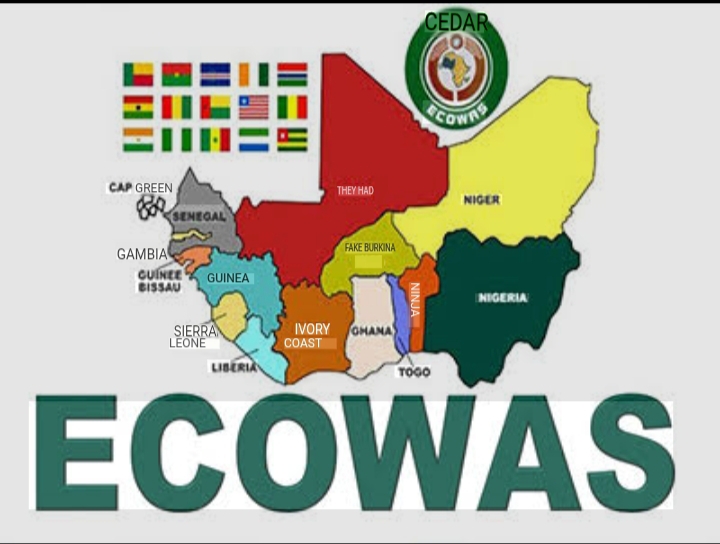
ECOWAS at a Crossroads: Democracy, Credibility and Institutional Reform
ECOWAS at a Crossroads: Democracy, Credibility and Institutional Reform
By Shu’aibu Usman Leman
As the leaders of the Economic Community of West African States (ECOWAS) gather in Freetown for the 2026 Heads of State Summit, the occasion offers far more than an opportunity for diplomatic engagement and ceremonial display. It provides a timely moment to reflect upon the state of one of Africa’s most significant regional organisations during a period of profound political uncertainty.
From military coups in parts of the Sahel to disputed elections, democratic backsliding, economic hardship and worsening insecurity, West Africa faces challenges that test not only the resilience of its member states but also the credibility of the institutions established to defend constitutional governance.
Against this backdrop, the Freetown summit has brought into sharper focus a fundamental question of whether ECOWAS can continue to command moral and political authority if its commitment to democratic principles is perceived as inconsistent? That question lies at the heart of the organisation’s future, for institutions derive legitimacy not merely from the treaties that establish them, but from the fairness, consistency and transparency with which they exercise their authority.
Since the adoption of its Protocol on Democracy and Good Governance in 2001, ECOWAS has earned recognition as one of Africa’s foremost defenders of constitutional rule. It has condemned military coups, suspended member states, imposed sanctions and deployed diplomatic initiatives aimed at restoring constitutional order.
These actions have reinforced its reputation as a regional guarantor of democratic governance. Yet, democracy cannot be defined simply by the absence of military rule; it also requires credible elections, strong institutions, accountability, respect for the rule of law and public confidence that political authority genuinely reflects the will of the electorate.
A regional organisation committed to defending democracy must, therefore, apply these principles consistently, regardless of whether the challenge arises from a military intervention or from concerns surrounding the integrity of an electoral process.
It is within this wider context that the decision to convene the 2026 summit in Freetown has attracted considerable attention. Sierra Leone’s 2023 presidential election continues to generate political debate.
Opposition parties, civil society organisations and several international observer missions expressed concerns regarding aspects of the electoral process, including the transparency of the publication of detailed polling results. Although the country’s constitutional institutions validated the election and President Julius Maada Bio continues to govern within the constitutional framework, those concerns have remained a part of the national political conversation.
At the same time, ECOWAS has responded firmly to unconstitutional changes of government in Mali, Burkina Faso and Niger through sanctions, suspension and sustained diplomatic pressure.
Whether intended or not, the contrast between these responses has contributed to a perception among some observers that the organisation applies one standard to military governments and another to civilian administrations whose electoral legitimacy has been questioned. Such perceptions matter because the authority of regional institutions ultimately depends as much upon public confidence as upon legal mandate.
These concerns extend well beyond Sierra Leone. The decision of Mali, Burkina Faso and Niger to withdraw from ECOWAS was accompanied by repeated accusations that the organisation had become more committed to preserving incumbent governments than to applying democratic principles consistently.
Whether one accepts those criticisms in full or not, they expose a broader institutional challenge. Trust cannot be sustained through legal authority alone; it must be reinforced through impartiality, transparency and the consistent application of agreed principles to every member state.
The summit has also brought into sharper focus an equally important question concerning the purpose and cost of regional diplomacy.
Shortly before the meeting commenced, a distinguished Ivorian journalist and former colleague of mine from the West African Journalists Association posed two deceptively simple questions directly to me: what will this summit ultimately cost, and why is it not being held at the ECOWAS Secretariat in Abuja, where it would be more cost-effective? Furthermore, what lasting benefit will it leave for the ordinary people of Sierra Leone? These questions deserve serious consideration.
President Julius Maada Bio, as Chairman of ECOWAS Heads of Government, has decided to take the summit to his country—perhaps to legitimise the disputed election that kept him in power—but at what cost? Such decisions clearly show the attitude of many leaders in the subregion who claim to be democratically elected yet exhibit authoritarian tendencies that do not benefit the impoverished masses of their respective countries. Such is the tragedy of leadership in African nations.
Across West Africa, governments continue to commit substantial public resources to hosting events that require extensive security operations, elaborate protocol, luxury accommodation and significant logistical expenditure.
Whilst host countries may benefit from infrastructure development and greater international visibility, too much public spending continues to be directed towards prestige rather than measurable public value. Once the final delegation departs, citizens will continue to confront rising living costs, unemployment, inadequate public services and persistent insecurity.
If ECOWAS is to restore and strengthen public confidence, institutional reform must accompany declarations of democratic commitment.
One important step would be the commissioning of an independent forensic audit of the organisation’s governance structures, financial management, administrative efficiency and decision-making processes.
The reforms undertaken within the African Union following the institutional review led by President Paul Kagame demonstrated that meaningful organisational reform is achievable where genuine political commitment exists. West Africans deserve the same level of transparency and accountability from their own regional organisation.
The Community should also desist from rotating statutory summits among member states. The African Union has demonstrated the advantages of convening its principal meetings at its permanent headquarters in Addis Ababa, reducing costs, improving administrative continuity and directing greater resources towards substantive programmes rather than ceremonial logistics.
ECOWAS should seriously consider adopting a similar approach by holding its statutory summits routinely at its headquarters in Abuja, whilst reserving rotational hosting for strategic initiatives where local engagement provides clear added value. Such a reform would represent more than a financial adjustment; it would affirm that institutional effectiveness takes precedence over political symbolism.
No programme of institutional renewal, however, can succeed without an independent and courageous media. Across West Africa, journalists continue to contend with political intimidation, economic vulnerability and growing restrictions upon press freedom.
Despite these challenges, the Fourth Estate remains indispensable to democratic accountability. Greater collaboration among investigative journalists across national boundaries would strengthen scrutiny of regional institutions, enhance transparency and reduce opportunities for the misuse of public resources.
The future credibility of ECOWAS will depend not upon the grandeur of its summits, but upon the integrity of its conduct.
Fiscal responsibility and democratic accountability are inseparable. An organisation that expects its member states to uphold constitutional governance, respect the rule of law and practise transparency must be prepared to demonstrate those same standards within its own institutions.
The Freetown summit should, therefore, serve not merely as another diplomatic gathering, but as an opportunity for genuine institutional introspection. Whether it becomes a turning point will depend not upon the eloquence of its communiqués, but upon the consistency with which ECOWAS applies its democratic principles, reforms its institutions and earns the confidence of the West African citizens in whose name it was established.
Leman is a former National Secretary of Nigeria Union of Journalists-NUJ.