
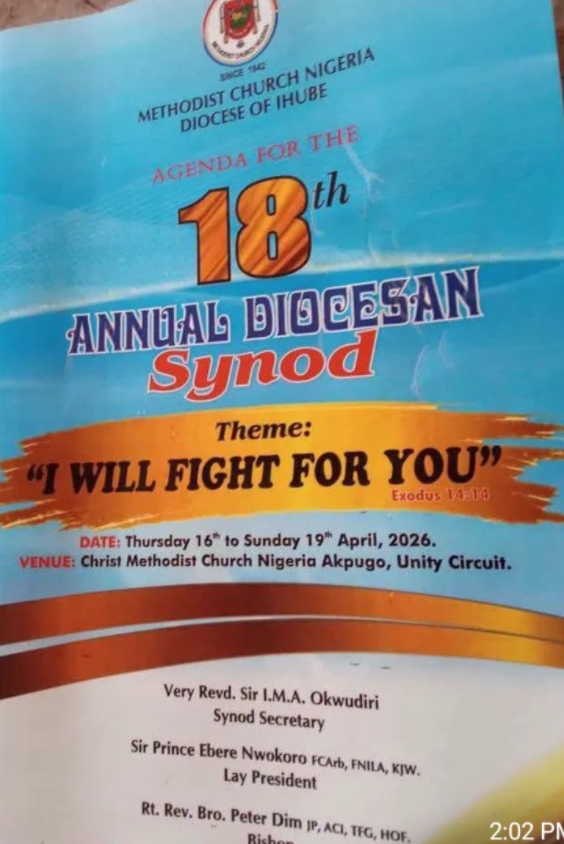
I8th Synod of Ihube Methodist Diocese Ends with Lamentation over State of Affairs in Nigeria
I8th Synod of Ihube Methodist Diocese Ends with Lamentation over State of Affairs in Nigeria
The 18th Synod of the Methodist Church Nigeria, Ihube Diocese with the theme: “I will fight for you (Exodus 14:14), has rolled to a close at the Christ Methodist Church, Akpugo (Unity Circuit ) with the church lamenting over the state of affairs in the country and challenging Christians to rise in prayers.
In his address the Prelate Methodist Church Nigeria, His Eminence, Dr Oliver Ali Aba noted the state of the nation is close to being perilous and however reminded Christians of how God saves his people each step along the way.

“Presently we are navigating issues relating to insecurity, economic instability and societal unrest. While our economic reforms appear on paper to be good, the reality is that the much-taunted growth appears not to be realistic in the lives of the average Nigerian, who are daily confronted with economic and
insecurity challenges.
“As you read Exodus, Let this illumine our understanding of how God works in our lives whenever we read the bible. That is why God in Christ Jesus entered into a world of death to bring us into new life. God has raised us from death to life, through the blood of Jesus Christ in John 3:14-18 and 11:40,” he observed.

The Methodist Prelate therefore enjoined all to intensify prayers to perfectly address what we see for now as our socio-economic and political uncertainties.
His Eminence Dr Ali Aba who reeled out directives and cautions to the Clergy and the lay of the church, appealed to members of the political class, civil servants, the elites and the non-elites to show concern about this nation.
Presenting his address the Bishop of Ihube Methodist Diocese, the Rt Rev Bro. Peter Dim, noted that Nigeria is a blessed and great nation with abundant human and material resources but regretted that selfishness and wickedness of leaders have turned things upside down.

He continued, “They are not ready to serve the people, but to serve themselves. Who will deliver us? Who will like Moses motivate and encourage our nation to stand still and see the healing God is bringing to Nigeria.”
According to him, there are multiplications in wickedness, hardship, hatred, mistrust, crying of hunger, death and heart failures amongst the people, while many are living in fears, doubts, and uncertainties.
The Methodist Bishop however assured that, “If we will be firm and be still, God will fight for us as we are looking forward to the 2027 General elections. God will fight for the masses.

“Methodist people, may we start now to pray for God’s intervention in the 2027 general election to give us a leader and leaders who know the way. Our prayers should be intensified so that God will give us people who will be concerned with the feelings and suffering of people in Nigeria.”
Bishop Dim used the occasion to thank God on the faithful for the attainments made in the Diocese for the past one year and called on Abroad members and other stakeholders to take more interest in the affairs of the church.
Addressing the Synod, Prince Ebere Nwokoro Lay President, Diocese of Ihube, described the theme as comforting, commanding, heaven‘s answer to earth‘s anxieties and a covenantal assurance of God‘s definitive response to human helplessness.

“The theological architecture of Exodus 14:14 is both profound and practical. Israel stood at a point of existential crisis-hemmed in, overwhelmed, and without human recourse. Yet, at that precise moment, God assumed the role of divine advocate and strategist,” he noted.
While pointing out that participants cannot divorce their ecclesiastical reflections from our national realities, the Lay President observed that Nigeria is today confronted by a troubling convergence escalating insecurity, crushing economic
hardship, heightened socio-political tension as the 2027 general elections approach.

“The atmosphere is thick with uncertainty. Many of our members are directly affected—economically strained, psychologically burdened, and spiritually tested.Yet, the Church must not become an echo chamber of despair. We are called to be a stabilizing force, a moral compass, and a sanctuary of hope,” Sir Nwokoro reminded all.
He noted that while commendable spiritual activities and certain structural activities have been recorded, some negative attitudinal challenges still persist.
According to him, “We continue to grapple with paucity of funds necessary to sustain
evangelism and mission work. This financial fragility has, at times, constrained our capacity to execute programs at the scale required.
“More concerning, however, is an emerging culture—subtle yet consequential—where some well-endowed members exhibit a reluctance to support the work of the Church, even when evidently able to do so.
“Allied to this is the tendency, in certain quarters, for members—and regrettably, even some clergy—to withhold or shield relationships, contacts, or children and friends of our members who possess the capacity to support the Church, thereby inadvertently stifling opportunities for growth and expansion.
“This is not merely an administrative concern; it is a theological misalignment. The work of God must never be constrained by human gatekeeping.
The lay President further lamented that the Diocese currently has no functional official vehicle for the Bishop, resulting in an unsustainable overreliance on the
Women‘s Fellowship minibus, which is itself overstretched, adding that the Diocesan Secretariat remains inadequately equipped, limiting administrative efficiency.
“Some of our social enterprise initiatives, including the Oil Mill and mission schools, continue to struggle with sustainability.
“In addition, it must be stated, without equivocation, that the Diocese has at times found it challenging to fully discharge its fiscal obligations to the Conference, a situation that calls for urgent corrective attention. These realities demand not lamentation—but decisive, collective action,” he emphasized.
Prince Sir Nwokoro, however, argued that notwithstanding these constraints, the Diocese has made some attainments including: replacement of the solar battery at the Bishop‘s Court through the voluntary generosity of committed stakeholders, infrastructural improvements across some of our circuits and local churches where renovations, minor expansions, and enhancements were carried out.
The Lay President further commended the Bishop, Rt. Rev. Bro Peter Dim, for the surge in spiritual activity such as Liberation Prayers, Kingdom Expansion Crusades, God‘s Visitation Crusades, Youth Rally 2025, among others.
On the way forward, Sir Nwokoro recommended that : “Youth members, many of whom possess smartphones, can
serve as digital evangelism anchors within each church.
“Churches can operate centralized WhatsApp groups at circuit level, managed by digitally literate members. Recorded sermons and teachings can be shared via Bluetooth, memory cards, and offline transfers, bypassing internet limitations.”

On repositioning with Intentional Structure, he stated: “It is instructive to recall that the Diocese previously established an
Investment Committee—a visionary initiative that unfortunately lost
momentum due to weak execution.
Synod should give serious consideration to reconstituting this Committee, replicating similar structures at Circuit level.
“However, this must not be a ceremonial exercise. Membership must be deliberately curated—individuals of proven integrity, competence, passion, and strategic thinking.
On micro-enterprises: he opined,
“The proposed collaboration with Wesley Microfinance Bank, particularly
around POS operations, was commendable but faltered due to ineffective coordination. This initiative remains viable and can be revived—provided a dedicated and accountable coordinator (an ―arrowhead‖) is appointed to drive it.”
To ensure an all round economic turnaround, Sir Nwokoro solicited the establishment of an Agro-based ventures (palm produce, cassava processing,
poultry), Structured cooperative societies, Community-based rental assets (chairs, canopies, etc.), enhancement of Mission schools among others.
“What is required now is transition from contemplation to implementation.
Let us move these ideas from being merely earmarked to being deliberately activated. Ministers should actively engage youth through WhatsApp fellowships, short devotional broadcasts, and interactive platforms.
“Youths should be entrusted with defined responsibilities within church administration and evangelism. Social media should be harnessed as a tool for identity, outreach, and retention.
“A Church that neglects its youth mortgages its future,” he concluded.