
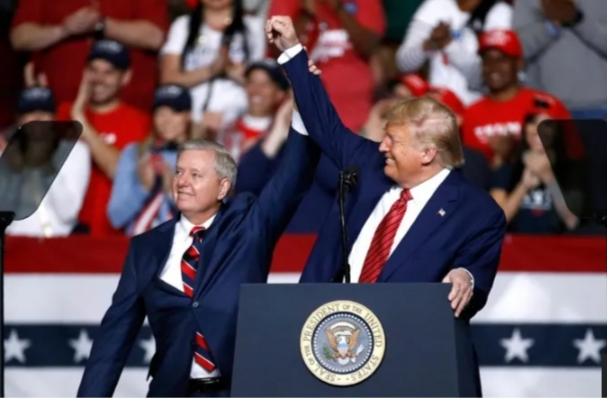
Lindsey Graham: The Republican Senator Who Rode the Winds of Political Change Dies, Leaving Behind a Complex Legacy
Lindsey Graham: The Republican Senator Who Rode the Winds of Political Change Dies, Leaving Behind a Complex Legacy
The death of longtime Republican Senator Lindsey Graham has triggered reflections on a political career that mirrored the dramatic transformation of the Republican Party and American politics during the era of Donald Trump.
For more than two decades in the United States Senate, Graham built a reputation as a conservative voice on national security, foreign policy, and America’s role in global affairs. But beyond his policy positions, his career became a remarkable study of political adaptation — moving from one of Donald Trump’s fiercest critics to one of the former president’s most dependable allies.
Graham, who represented South Carolina in the Senate for 23 years, was once closely associated with the late Senator John McCain, a Republican known for his independence and willingness to challenge his own party. Their partnership reflected Graham’s earlier political identity as a conservative who valued bipartisan cooperation.
When Graham launched his own presidential campaign in 2015, he campaigned on reducing partisan hostility in Washington, famously suggesting that leadership required lawmakers to sit together, debate issues, and find common ground.
However, the rise of Donald Trump dramatically changed the political environment Graham operated in.
During the 2016 Republican primary, Graham became one of Trump’s most outspoken critics. He condemned Trump’s comments about McCain’s military service, calling him unfit for the presidency. Their feud escalated after Trump publicly revealed Graham’s phone number during a rally, leading to a flood of hostile messages directed at the senator.
At the height of his opposition, Graham warned that if Republicans nominated Trump, the party would suffer political damage and “deserve it.”
Even after Trump won the 2016 presidential election, Graham initially remained cautious. But as Trump reshaped the Republican Party, Graham’s position changed significantly.
He became one of Trump’s closest allies in Congress, frequently defending the president’s policies, appearing regularly on television, and supporting key decisions by the administration.
One of the defining moments of Graham’s influence came during the confirmation battle of Supreme Court Justice Brett Kavanaugh. Graham strongly defended Kavanaugh against allegations of sexual misconduct, which Kavanaugh denied, helping secure his confirmation in a closely divided Senate vote.
However, Graham’s relationship with Trump briefly fractured after the 2020 presidential election, when Trump refused to accept defeat by Joe Biden.
Following the January 6, 2021 attack on the US Capitol by Trump supporters, Graham publicly declared that he was distancing himself from Trump, saying their political journey had reached a painful conclusion.
But that separation did not last.
Graham later supported Trump during his return to national political dominance and defended his presidency, arguing that he judged Trump based on his record in office. By the 2024 election cycle, Graham was once again firmly aligned with Trump’s political movement.
Despite his close relationship with Trump, Graham maintained friendships across party lines. Several Democratic lawmakers who disagreed with his politics still acknowledged his ability to build personal relationships and negotiate across the aisle.
Trump himself highlighted this quality, noting that Graham could communicate with Democrats and help resolve disagreements.

The Battle to Replace a Senate Veteran
Graham’s passing has created uncertainty for Republicans in Washington and South Carolina. The senator was preparing for another term and had already secured his party’s nomination without opposition.
South Carolina Governor Henry McMaster is expected to appoint an interim replacement, while Republicans will organize a fresh primary election to determine the party’s candidate for the November general election.
Although South Carolina remains a strongly Republican state, the open Senate seat could become a significant political contest if national political conditions shift.
Whoever succeeds Graham will inherit a position once occupied by a senator with decades of experience, deep relationships across party lines, and considerable influence in Washington.
Lindsey Graham’s legacy will likely remain one of the most debated political stories of his generation — a career defined by conservative principles, changing alliances, and the extraordinary political transformation brought about by the Trump era.